
Skip to content
Brilliant Blue Biosciences logoBrilliant BlueBiosciences
Research area

Drug Delivery

6 sub-topics covering the mechanisms, design trade-offs and experimental methods that define this area of our work.

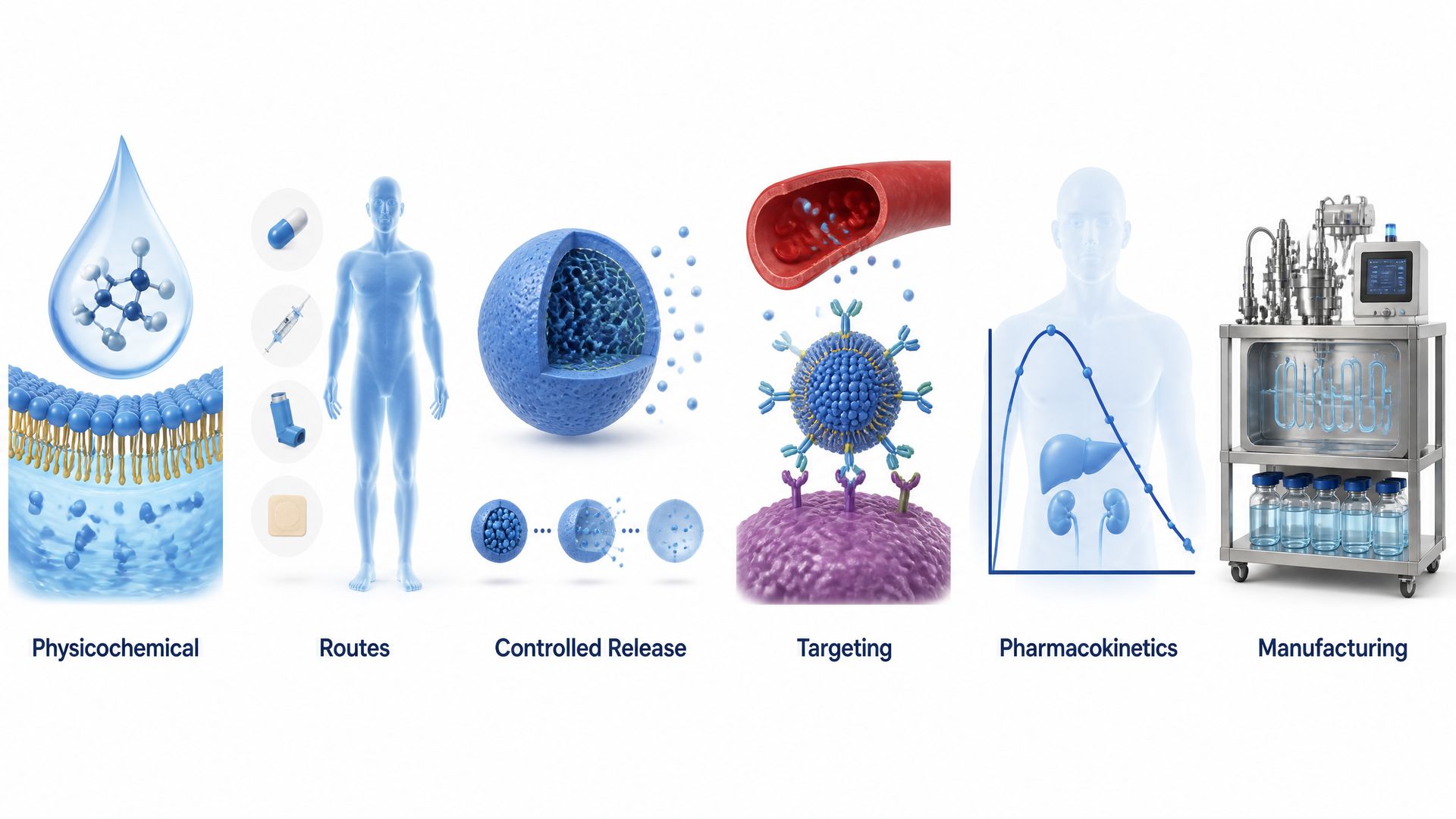
Six drug delivery concepts: physicochemical principles, routes of administration, controlled release, targeting, pharmacokinetics and manufacturing
01

Physicochemical Principles

Solubility, partition coefficient, ionisation and molecular size — the properties that decide whether a molecule can ever reach its target.

Before any carrier is designed, the payload's own chemistry sets the ceiling. Lipinski-style rules, the pH-partition hypothesis and the Biopharmaceutics Classification System frame which barriers are addressable at all.

02

Pharmacokinetics & Biodistribution

Absorption, distribution, metabolism and excretion of a therapeutic — and how a carrier rewrites each of those curves.

Attaching a carrier changes the whole kinetic profile: circulation half-life, volume of distribution and clearance route. We model these shifts before committing to a formulation.

03

Routes of Administration

Oral, intravenous, subcutaneous, pulmonary, transdermal and intranasal routes, each with its own biological constraints.

The route determines the first barrier a delivery system meets. Matching carrier architecture to route — rather than forcing a preferred formulation onto every indication — removes most early attrition.

04

Controlled & Sustained Release

Polymeric matrices, reservoirs and stimuli-responsive systems that set the timing of payload release.

Release kinetics can be programmed by diffusion, degradation or an external trigger such as pH, temperature or enzymatic activity — turning a single dose into a defined therapeutic window.

05

Active & Passive Targeting

Exploiting leaky vasculature and the enhanced permeability and retention effect, or decorating surfaces with ligands for receptor-mediated uptake.

Passive accumulation relies on tumour vasculature architecture; active targeting adds a molecular address. The two are complementary, and the second only works when the first is under control.

06

Translation & Manufacturing

Turning a laboratory formulation into a reproducible, regulator-approved product.

Scale-up, sterility assurance, critical quality attributes and stability programmes decide whether a promising delivery system ever reaches a patient. We design for these from the first batch.

Related articles

All articles →
International journal of nanomedicine · 2026

Pomegranate Seed Oil Biologically Engineered Lactobacillus Extracellular Vesicles with Enhanced Yield and Brain Delivery via ApoE-Enriched Protein Corona

The blood-brain barrier (BBB) is a major bottleneck for nanomedicine-based treatment of central nervous system (CNS) disorders. Lactobacillus -derived extracellular vesicles (LEV) are promising biocompatible nanocarriers, but their low production yield and limited BBB permeability hinder their development. We hypothesized that stimulation of Lactobacillus with pomegranate seed oil (PSO), or its nanoemulsion (PSO NE), could remodel the LEV membrane to simultaneously enhance vesicle production and brain accumulation. Lactobacillus was stimulated with PSO or PSO NE to generate engineered LEV.

International journal of nanomedicine · 2026

Advanced Nanocarriers for Delivering Traditional Chinese Medicine Monomers in Rheumatoid Arthritis: Prospects and Challenges

Rheumatoid arthritis (RA) is an auto-immune disease that is accompanied by constant inflammation and degradation of joints, causing disabilities and poor quality of life. Even though the available therapies alleviate symptoms, long-term use is often linked with loss of effectiveness, systemic toxicity, and poor patient compliance. Recently, bioactive monomers that can be extracted from Traditional Chinese Medicine (TCM) gained attention due to their anti-inflammatory, immunomodulating and antioxidant effects.

International journal of nanomedicine · 2026

Next-Generation Cancer Nanovaccines: Reprogramming the Tumor Microenvironment from Rational Design Toward Clinical Translation

Cancer vaccines have emerged as a promising immunotherapeutic strategy for inducing durable and tumour-specific immune responses; however, their clinical efficacy remains limited by poor antigen immunogenicity, inefficient delivery, tumor heterogeneity, and the highly immunosuppressive tumor microenvironment (TME).