
LDH Assay (Lactate Dehydrogenase)
Membrane damage measured by LDH released into the culture medium.
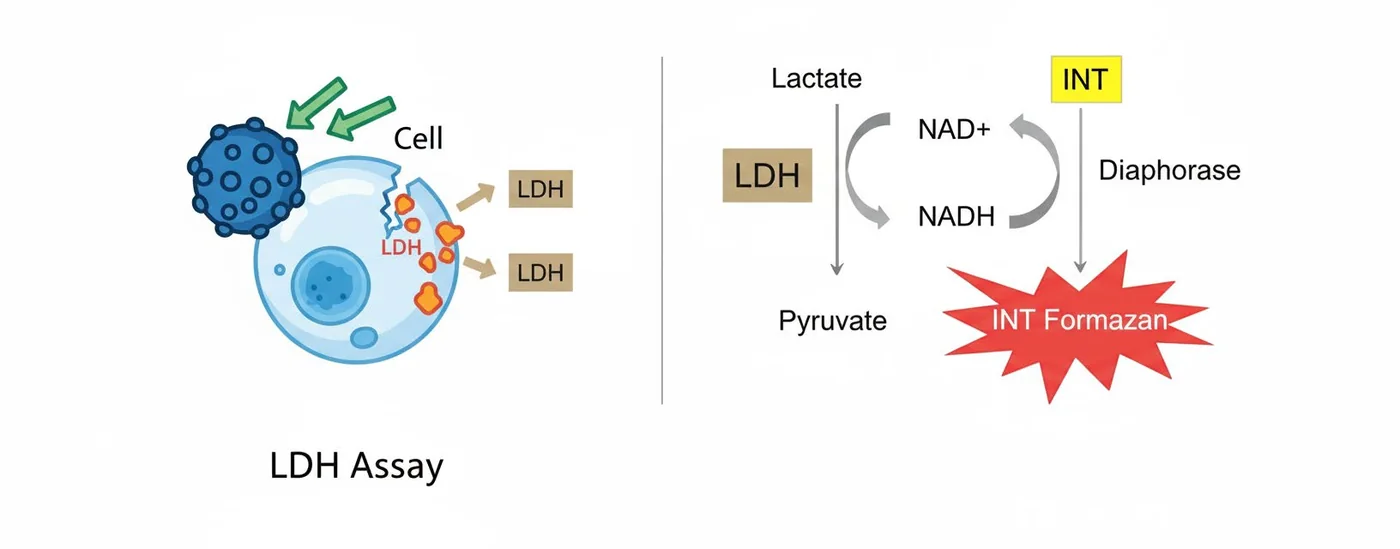
To quantify cell death (especially necrosis), assess membrane integrity and support toxicity studies.
LDH is a stable cytoplasmic enzyme released into the culture medium upon cell membrane damage (necrosis or late apoptosis). LDH catalyses the reduction of NAD⁺ to NADH while converting lactate to pyruvate; NADH then reduces a tetrazolium salt (e.g., INT or WST) to a red formazan product.
Standard protocol
Protocol (typical)
- 1
Seed and treat cells as usual.
- 2
Centrifuge the plate (optional) and transfer the supernatant to a new 96-well plate.
- 3
Mix supernatant with LDH reaction mixture (substrate, NAD⁺ and detector).
- 4
Incubate at room temperature or 37 °C for 15–30 min in the dark.
- 5
Stop the reaction (if required) and measure absorbance at 490 nm.
- 6
Include controls
- Spontaneous LDH release (untreated cells).
- Maximum LDH release (lysed cells with detergent, e.g., Triton X-100).
(Test − Spontaneous) ÷ (Maximum − Spontaneous) × 100
Let's engineer the next delivery breakthrough together
We co-develop nanocarrier and biosensing programs with pharma, biotech and academic groups — from target selection through GMP supply.