
Cellular Uptake & Endocytosis
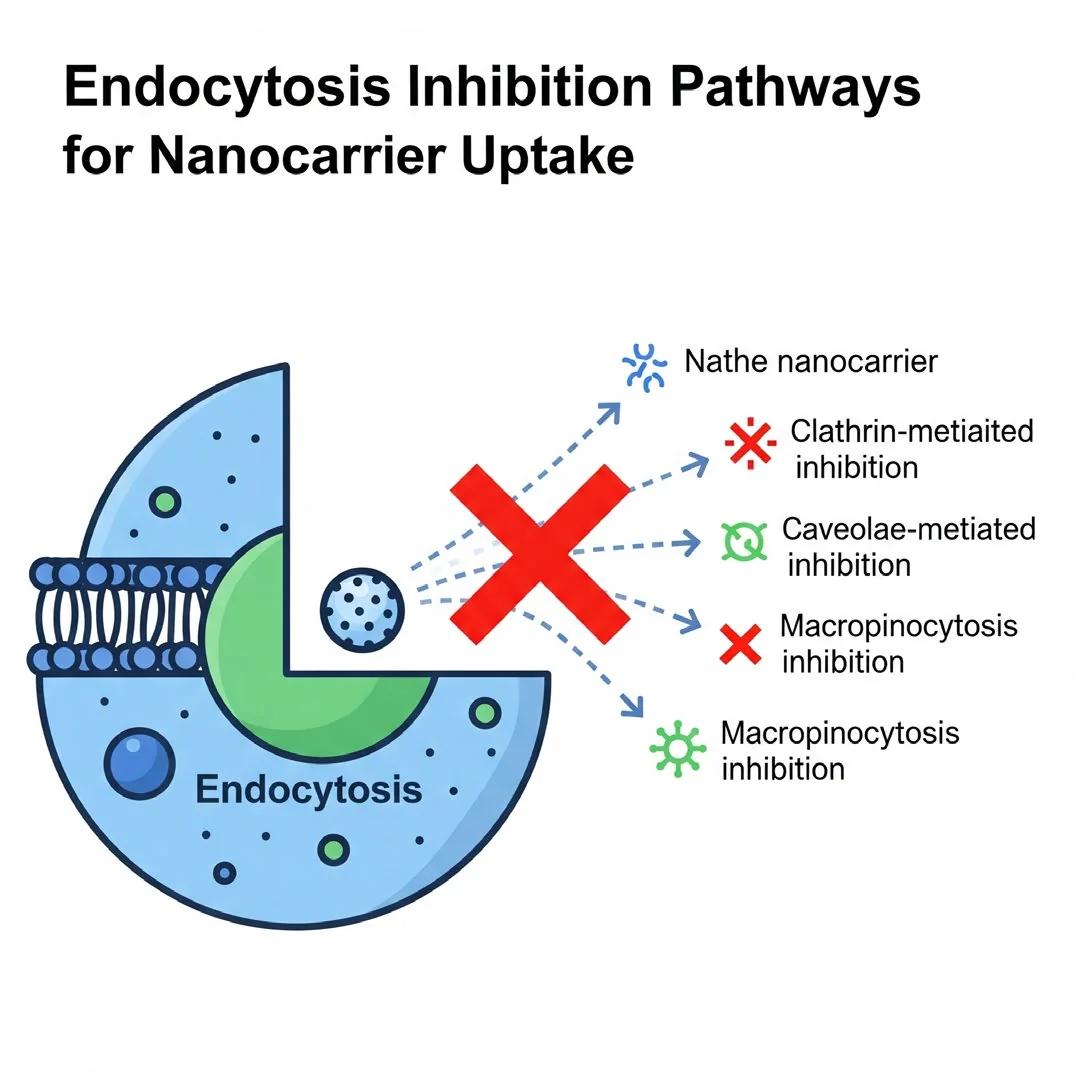
Endocytosis Inhibition Pathways for Nanocarrier Uptake
Pharmacological inhibitors reveal which endocytic route a carrier uses.
Purpose
To determine the cellular internalisation mechanism (endocytic pathway) of nanocarriers (e.g., nanoparticles, liposomes) by selectively inhibiting different endocytosis pathways and measuring the resulting uptake.
Background
- Clathrin-mediated endocytosis (CME)
- Caveolae-mediated endocytosis
- Macropinocytosis
- Clathrin- and caveolae-independent pathways
- By using specific pharmacological inhibitors or low temperature, a particular pathway can be blocked to assess how it affects nanocarrier uptake.
Standard protocol
- 1
Cell seeding
- Seed cells in 24-well plates or chamber slides (e.g., 5 × 10⁴ cells/well) and incubate overnight at 37 °C, 5% CO₂.
- 2
Inhibitor treatment
- Pre-treat cells with inhibitors for 30–60 min at 37 °C: chlorpromazine (CME), genistein (caveolae), EIPA or amiloride (macropinocytosis), MβCD (cholesterol depletion).
- Include a DMSO-only (vehicle) control.
- For the 4 °C control: move cells to ice and keep them on ice throughout.
- 3
Nanocarrier incubation
- Add fluorescent nanocarriers to each well.
- Incubate at 37 °C for 30–120 min, or at 4 °C (negative control for energy-dependent uptake).
- 4
Washing
- Remove medium and wash cells 3× with cold PBS to remove surface-bound nanocarriers.
- Optional: use trypan blue or a similar quencher to quench extracellular fluorescence.
- 5
Analysis
- Flow cytometry: measure mean fluorescence intensity (MFI) to quantify uptake.
- Confocal microscopy: visualise intracellular localisation.
- Normalise uptake to control (DMSO or 37 °C untreated).
- 6
Controls
- Positive control: a known endocytosed particle (e.g., transferrin for CME).
- Negative control: 4 °C incubation.
- Viability check (e.g., MTT) to ensure inhibitors are not cytotoxic at the concentrations used.
Data interpretation
- Reduced uptake with chlorpromazine → clathrin-dependent pathway.
- Reduced uptake with genistein or MβCD → caveolae/lipid raft-dependent.
- Reduced uptake with EIPA → macropinocytosis involved.
- No uptake at 4 °C → energy-dependent process.
Let's engineer the next delivery breakthrough together
We co-develop nanocarrier and biosensing programs with pharma, biotech and academic groups — from target selection through GMP supply.