
Skip to content
Brilliant Blue Biosciences logoBrilliant BlueBiosciences
2
Question 2 of 3

What is my cell type?

Cell type is the strongest predictor of success and the most common reason a published protocol fails in a new lab. Immortalised lines are engineered for growth and endocytic activity; primary cells keep the membrane regulation and immune sensing of the tissue they came from.

Answer matrix

Each answer, and the route it implies

HEK293 / HEK293T

Go to: Most lipid and polymer reagents work; Lipofectamine 3000, TurboFect, PEI

Why: High endocytic activity, robust growth, tolerate reagent excess

Watch out: Rapid division means plasmid signal dilutes fast — read out within 72 h

HeLa / COS-7

Go to: Lipofectamine 2000 and 3000, X-tremeGENE HP, TurboFect

Why: Classic permissive lines used in most published protocols

Watch out: Batch-to-batch mycoplasma and passage drift are common confounders

CHO-K1 / CHO-S

Go to: X-tremeGENE HP, FuGENE HD, PEI-based reagents

Why: Bioproduction host with good suspension tolerance

Watch out: Liposomal reagents often underperform; validate on the exact production clone

Primary T cells, NK cells

Go to: Nucleofection with RNP; mRNA or lipid only with immune-tuned formulations

Why: Cytosolic nucleic acid sensors make DNA and unmodified mRNA poorly tolerated

Watch out: Activation status changes the optimal pulse program and recovery conditions

iPSC / ESC

Go to: Nucleofection, or lipid reagents in feeder-free defined media

Why: Slow division makes plasmid nuclear delivery inefficient; single-cell stress triggers differentiation

Watch out: Viability after delivery is as important as efficiency — clonal expansion depends on it

Primary neurons, hepatocytes, fibroblasts

Go to: FuGENE HD, Effectene, MessengerMAX, magnetofection

Why: Post-mitotic or fragile cultures need low-toxicity reagents

Watch out: Effectene requires a wash step; residual serum strongly inhibits it

What actually differs between cell types

Endocytic capacity is the main axis. Transformed lines internalise large volumes of membrane per hour; primary lymphocytes in circulation have almost no basal endocytosis until activated. Reagent concentration that saturates a HeLa monolayer may barely engage a resting T cell.

Membrane composition differs too. Cholesterol-rich, ordered membranes resist fusion with lipoplexes, while highly fluid membranes fuse readily. This is why helper-lipid choice and even the culture's fatty-acid content can change results between labs using the same kit.

Immune sensing is the third axis and the one most often ignored. Primary cells express cytosolic DNA and RNA sensors; introducing plasmid DNA or unmodified mRNA can trigger type I interferon responses that kill the culture or silence the construct — a delivery failure that looks like biology.

  • For primary cells, deliver pre-assembled RNP rather than nucleic acid encoding the nuclease.
  • For iPSC, keep delivery stress low: fewer pulses, gentler programs, and a recovery period in conditioned medium containing ROCK inhibitor.
  • For suspension cells, prefer reverse transfection or electroporation — lipid overlay protocols assume a settled monolayer.
  • For bioproduction clones, validate on the exact clone at the intended scale, not on a laboratory progenitor.
Passage number is part of the cell type

Reagent vendors optimise on low-passage cells. Endocytic activity falls with passage and the membrane composition drifts, so a protocol that gives 90% efficiency at passage 5 can give 40% at passage 30. Define a working range — commonly 3–15 passages from thaw for HEK293 — and freeze fresh working stocks rather than passaging indefinitely.

When to change method rather than reagent

If several lipid reagents fail in the same primary cell type, the problem is the delivery route, not the formulation. Move to nucleofection. If viability, not efficiency, is the limiting factor, move to a low-toxicity physical method such as magnetofection, or accept a lower payload dose in a gentler formulation.

Decision rules

If this, then that

  • If Immortalised adherent lineStart with a lipid reagent, titrate the ratio, and expect success within one optimisation pass
  • If Suspension or bioproduction lineUse a polymer or a production-grade reagent validated on the clone, not a liposomal kit
  • If Primary immune cellRNP electroporation with a validated program and warm recovery medium
  • If Stem cell or iPSCNucleofection with a gentle program, or a low-toxicity lipid in defined medium
  • If Post-mitotic primary cellmRNA or RNP rather than plasmid DNA, in a low-toxicity carrier
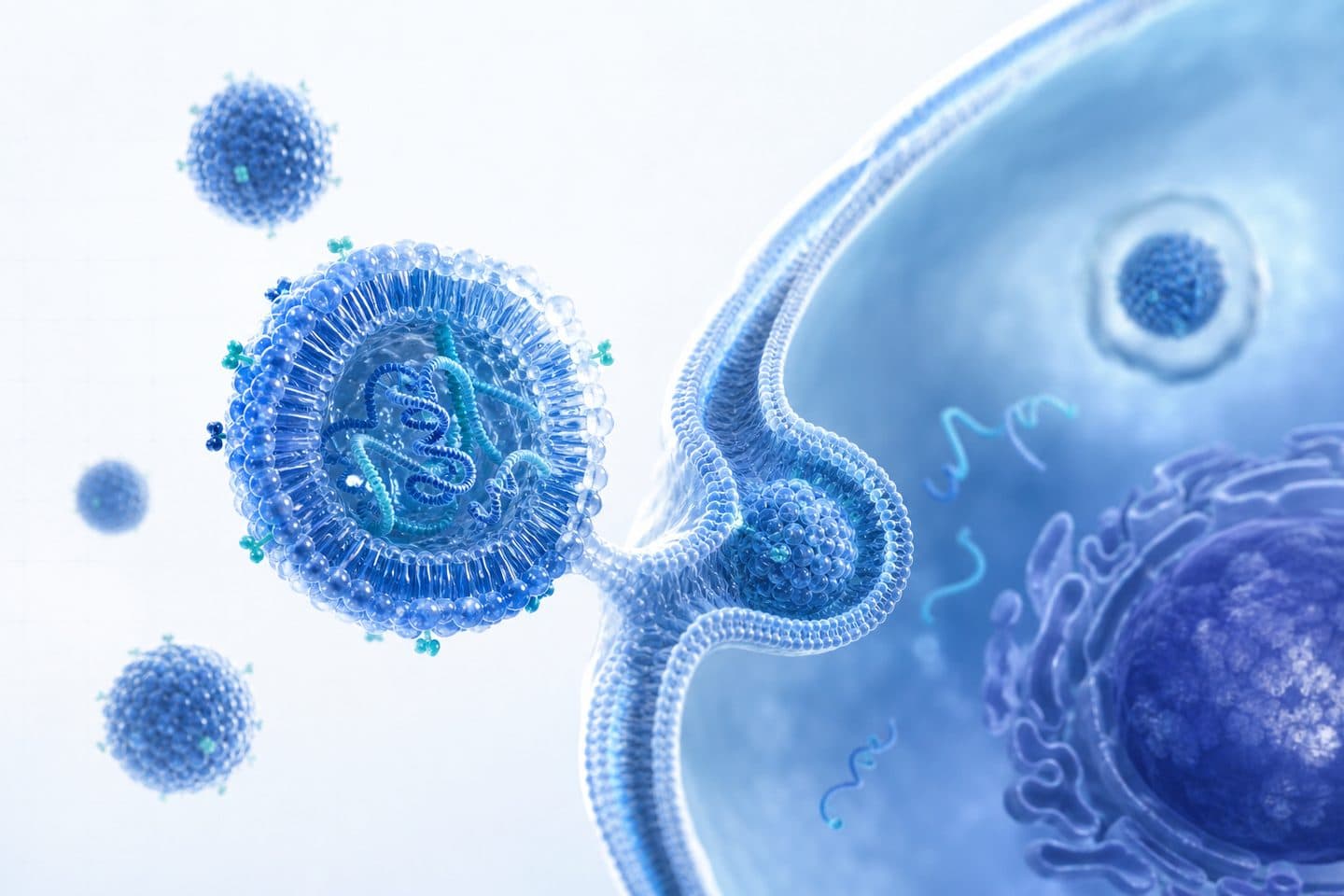
Lipid nanoparticles approaching and fusing with a cell membrane, nucleus in the background
Membrane, endocytic activity and immune sensing differ from one cell type to the next.
Provenance

References for this decision

Every protocol on this page was reconstructed from the manufacturer’s own documentation. Use these links to confirm concentrations, catalogue numbers and cell-line-specific variants before running the experiment.

  1. [1]Thermo Fisher — Transfection protocols by cell type
  2. [2]Lonza — Cell-type specific Nucleofector protocols
  3. [3]Sigma-Aldrich — Cell-line transfection recommendations