
Skip to content
Brilliant Blue Biosciences logoBrilliant BlueBiosciences
1
Question 1 of 3

What is my payload?

The payload decides the route before any reagent is chosen. A plasmid needs nuclear access; mRNA, siRNA and RNP act in the cytoplasm. That single distinction eliminates half the options and explains most disappointing results.

Answer matrix

Each answer, and the route it implies

Plasmid DNA (3–10 kb)

Go to: Cationic lipid or polymer that condenses and protects DNA

Why: Needs condensation against nucleases plus nuclear delivery; works best in dividing cells

Watch out: Transient expression peaks at 48–72 h and dilutes with division; plasmid integration is a risk in therapeutic work

mRNA

Go to: Ionisable lipid nanoparticle or an RNA-optimised lipid reagent

Why: Translates directly in the cytosol; no nuclear step, so non-dividing cells work

Watch out: Degraded by RNases and sensed by innate immune receptors; base modification and cold handling matter

siRNA / miRNA

Go to: RNA-optimised lipid reagent, often in reverse transfection

Why: Must load into RISC in the cytoplasm quickly and at high copy number

Watch out: Knockdown depth depends on target protein turnover — check transcript and protein at different times

CRISPR RNP

Go to: Nucleofection for primary cells; lipid reagent for adherent lines

Why: A large protein–RNA complex needs efficient endosomal escape and fast cytosolic release

Watch out: Protein cargo costs more and the complex must be used fresh; validating the ratio is essential

Large DNA (BAC, minicircle)

Go to: Polymer carriers or physical methods

Why: Large constructs condense poorly with lipids and are harder to package

Watch out: Lipid complexation becomes inefficient above roughly 15 kb; consider electroporation instead

Size changes the chemistry

Small cargo makes small particles. siRNA is ~13 kDa and forms a compact 50–100 nm complex; a 10 kb plasmid is roughly 6.5 MDa and tends to form larger, more heterogeneous lipoplexes. As plasmid size grows, the fraction of the dose that reaches the nucleus falls, because both endosomal escape and nuclear entry become less likely.

This is why protocols for large constructs shift toward physical methods. Electroporation does not depend on condensation geometry, so it delivers a 40 kb construct almost as easily as a 4 kb one — at the cost of viability.
Co-delivery is its own problem

CRISPR plasmid work, AAV production and two-plasmid reporter systems all require more than one nucleic acid in the same cell. Co-delivery efficiency is the product of the individual efficiencies if the two are delivered as separate complexes, so a 70% single-plasmid efficiency becomes roughly 49% for two plasmids. Carrying both in one particle removes that squaring penalty, which is a strong argument for RNP or pre-mixed co-complexation.

  • Keep the total nucleic acid mass constant and split it between the constructs when co-transfecting.
  • Verify co-delivery with two distinguishable reporters rather than assuming both went in together.
  • For three-plasmid vector production, titrate the limiting plasmid separately — the ratio, not the total, sets titre.

Formats that buy time or fidelity

Choose mRNA when you want strong transient expression in cells that do not divide, and RNP when you want the shortest possible activity window and the cleanest editing outcome. Choose plasmid DNA when you need sustained expression, selection or the cheapest possible route to a stable line.

Decision rules

If this, then that

  • If Payload must act in the nucleus (plasmid, minicircle)Choose a carrier with strong nuclear delivery in dividing cells, and plan a 48–72 h readout
  • If Payload acts in the cytoplasm (mRNA, siRNA, RNP)Choose an RNA- or protein-optimised reagent and a 6–48 h readout
  • If Payload exceeds 15 kbMove to electroporation or a polymer carrier; lipid efficiency drops sharply
  • If Two or more payloads must reach the same cellPre-mix into a single complex, or accept the squared co-delivery penalty
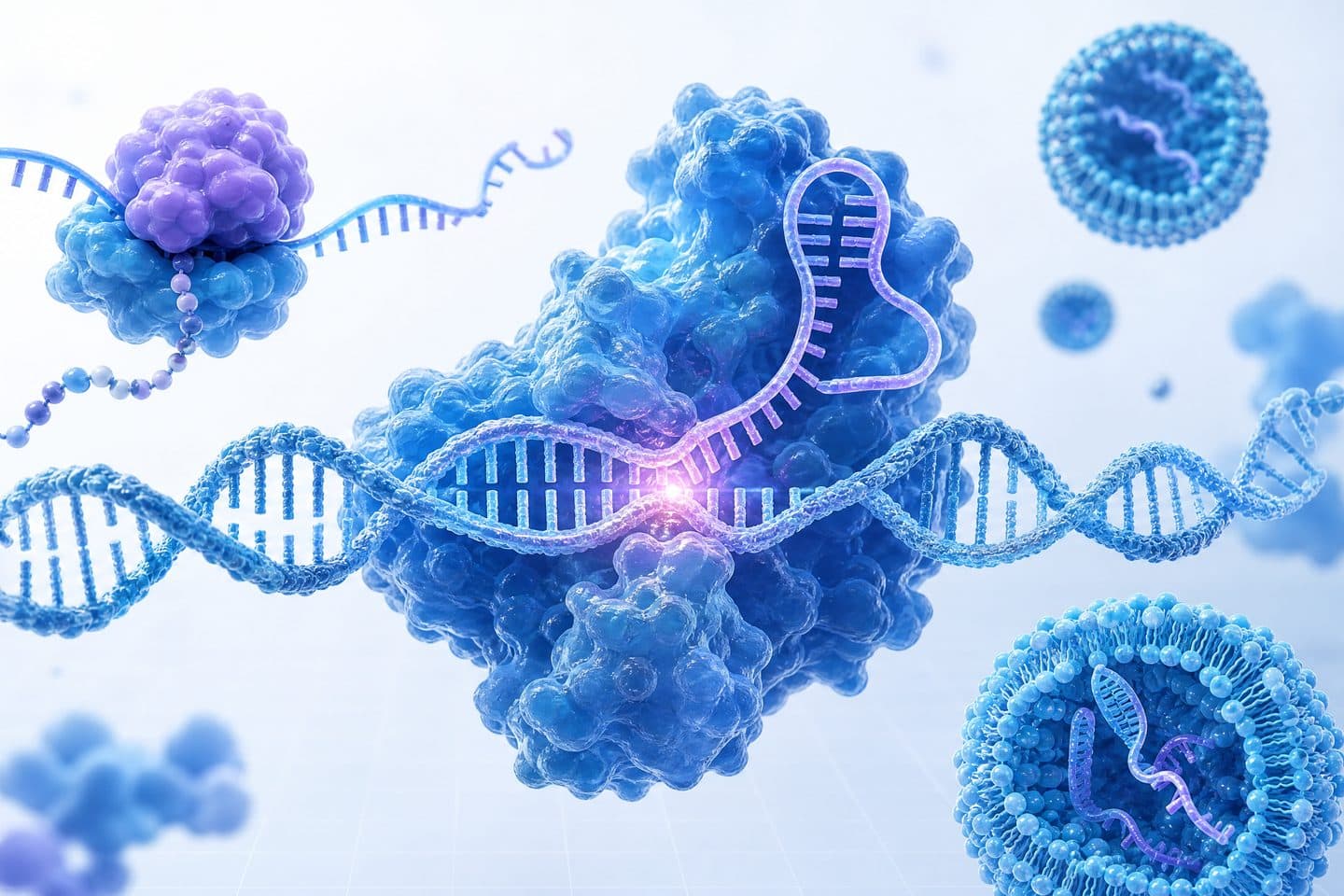
Cas9 editing a DNA helix beside mRNA and lipid nanoparticles carrying genetic cargo
Plasmid, mRNA, siRNA or RNP: each cargo has its own destination inside the cell.
Provenance

References for this decision

Every protocol on this page was reconstructed from the manufacturer’s own documentation. Use these links to confirm concentrations, catalogue numbers and cell-line-specific variants before running the experiment.

  1. [1]Thermo Fisher — Choosing the right transfection reagent for your payload
  2. [2]Promega — Nucleic acid delivery formats and reagent selection
  3. [3]IDT — CRISPR RNP delivery formats