
Nucleic Acid Binding, Loading & Release
Fourier Transform Infrared Spectroscopy (FTIR)
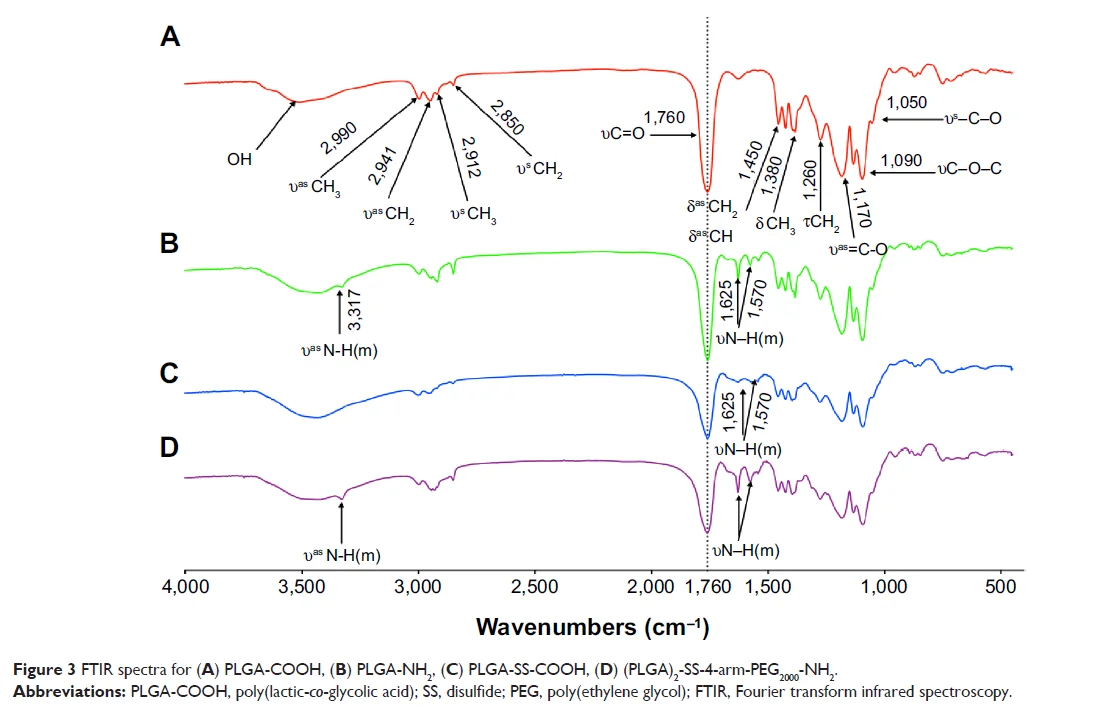
Chemical fingerprint — functional groups and carrier–nucleic acid interactions.

Purpose
To analyse chemical structure and molecular interactions (e.g., between cationic lipids/polymers and nucleic acids), confirm successful synthesis and detect functional groups.
Principle
Molecules absorb specific frequencies of infrared light corresponding to bond vibrations (e.g., C=O, N-H, P=O). The resulting spectrum acts as a “molecular fingerprint”.
Standard protocol
- 1
Sample preparation
- Dry the sample (e.g., lyophilise 1 mL of nanoparticle suspension).
- For ATR-FTIR: place a small amount of solid on the crystal and apply pressure.
- For transmission: mix 1–2 mg sample with 100–200 mg KBr and press into a pellet.
- 2
Measurement
- Scan range: 4000–400 cm⁻¹.
- Resolution: 4 cm⁻¹.
- Scans: 32–64 for good signal-to-noise.
Data interpretation
- Phosphate (P=O): ~1080–1240 cm⁻¹ → confirms nucleic acid presence.
- Amine (N–H): ~1500–1650 cm⁻¹ → indicates cationic polymer/lipid.
- Shift or broadening of peaks → suggests interaction (e.g., electrostatic binding between a positive carrier and negative DNA).
Representative data
Let's engineer the next delivery breakthrough together
We co-develop nanocarrier and biosensing programs with pharma, biotech and academic groups — from target selection through GMP supply.